Pay in installments of $6.85 with
 ,
,
 and
and

Shipping Estimate
USA
- USA
- CAN
- USA
- CAN
Ships within 48 hours · Estimated delivery Jul 2 - Jul 7
 Promo Codes Available:
For Your Every Summer RSVP, with Code: SUMMER15
Description
nutube pedal Korg Nutube 6P1 Dual Triode – The diyAudio StoreThe Korg Nutube 6P1 is a new, miniature, low power dual directly heated triode device. It was developed by Korg (of musical instrument fame) and Noritake Itron, a manufacturer of vacuum fluorescent displays, in Japan. Although it is a true directly heated triode, it is manufactured differently than traditional vacuum tubes, which gives it some unique attributes. Electrically, the Nutube 6P1 is somewhat comparable to the battery powered hearing aid
The Korg Nutube 6P1 is a new, miniature, low-power dual directly-heated triode device. It was developed by Korg (of musical instrument fame) and Noritake Itron, a manufacturer of vacuum fluorescent displays, in Japan. Although it is a true directly heated triode, it is manufactured differently than traditional vacuum tubes, which gives it some unique attributes.
Electrically, the Nutube 6P1 is somewhat comparable to the battery-powered “hearing aid” tubes. It operates on very low voltages – the filament is rated at 700mV, and plate supply voltages can be as low as 5V.
Electrical Characteristics
The Nutube is a very low power device – the filament consumes only 12mW of power per triode, and the plate dissipation is rated at only 1.7mW! The consequence of such low power operation is that, compared to most traditional vacuum tubes, it also has quite low transconductance (gm).
Refer to Table 1 for a summary of the electrical specs of the 6P1.
| Typical Characteristics – Nutube 6P1 (each triode) | ||
|
|
|
|
|
|
|
|
|
|
|
|
|
|
|
|
|
|
|
|
|
|
|
|
|
|
|
|
|
|
|
|
|
|
|
|
|
|
||
|
|
|
|
|
|
|
|
|
|
|
|
Table 1 - Nutube 6P1 Electrical Characteristics
Even though the numbers are a bit different than a common tube like the 12AX7, a first look at the plate characteristic curves (Figure 1) will look very familiar.
Figure 1- Plate Characteristics
The curves are typical for a triode and are quite linear. However, when selecting an operating point and load line, one must observe the maximum plate dissipation and maximum permitted plate voltage, which constrains operation significantly. Also notable is the fact that to get much of an output signal with a low plate voltage, the grid must be operated in the positive region – class A2.
Since much of the advantage of the Nutube is the ability to be operated on low-voltage power supplies, most applications will utilize a positive grid bias. This means that some grid current will flow, and a somewhat low impedance source (like a source follower) must be used to drive the grid.
The grid current is shown in Figure 2 below. You can see that the grid current, although only tens of microamps, is significant when compared with the low plate current.
Figure 2 - Nutube 6P1 Grid Current
Mechanical and Physical Attributes
The Nutube is manufactured by Noritake-Itron in Japan, using a similar process as vacuum fluorescent displays. It is, in fact, a one-pixel VFD device. The plate is coated with a phosphor just like a VFD, and it glows a blueish-white color when plate current is flowing.
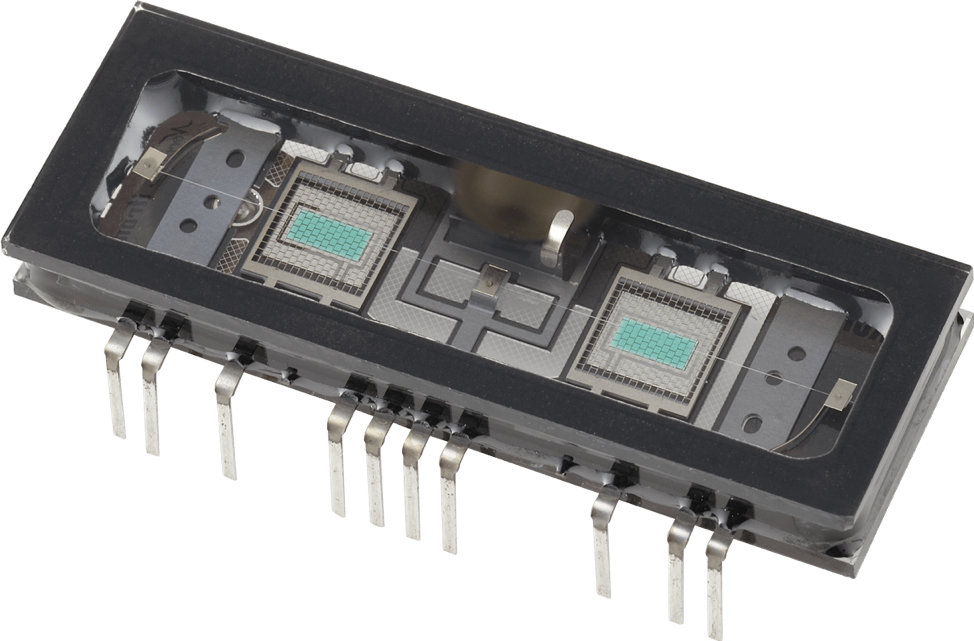
A close look at a 6P1 triode (Photo 1) shows a very fine coated wire running across the device. This is the filament. Even though it is heated enough to emit electrons, it does not get hot enough to show a visible glow. Below the filament there is a fine, open mesh – this is the grid. Below that is a metal plate with the phosphor (glowing) applied – this is the plate.
Photo 1- Nutube 6P1 Close-Up
Two triodes are packaged together into one glass package, which is again borrowed from VFD manufacturing. It looks a bit like an old 40-pin DIP IC package, but has pins only along one edge. See Photo 2.
Photo 2 - Nutube 6P1
The two filaments share a common center terminal. In most applications, this terminal is at ground potential. Because of this, circuits like cathode followers or differential amplifiers are a bit more difficult to implement, as they require a floating filament supply.
One notable side effect of the construction is that the filament wire, under tension, is a lot like a piano string - when subjected to a shock or mechanical impact, it vibrates at an audible frequency (maybe 5kHz or so). This microphonic behavior seems identical to that of the subminiature battery tubes, and could cause problems when the Nutube used in low signal applications. In some cases it may be desirable to mechanically isolate or shock mount the tube.
The package is a glass sandwich, 45mm x 16mm, and is designed to mount to a PC board, with pins spaced on 2mm centers (Figure 3). A small metal disc on the back of the package is used to seal the port where the air is exhausted.
Figure 3- Nutube 6P1 dimensions
Reference and Example Circuits
The basic application circuit provided by Korg (Figure 4) uses simple JFET source followers to buffer the signal in and out of the Nutube. An input buffer is used to support the relatively low impedance looking into the grid and bias source. The output buffer is needed to drive anything but very high impedance loads, due to the low transconductance and resultantly high plate resistance of the tube.
Figure 4- Korg Application Circuit
This circuit is intended to operate from a single power supply between about 5V to 30V, plus a regulated 3.3V supply (typically from an LDO regulator). Bias is adjustable from 0 to +3.3V. To support the grid current, a relatively low value resistor (33kΩ) is used to provide DC bias to the grid. This then mandates that a large (10µF) coupling capacitor be used to couple the audio signal. There is no doubt some bias shift with signal level in this arrangement, but with the values shown it doesn’t appear to be significant.
Filament power is obtained from the 3.3V supply with a dropping resistor.
Another circuit example is shown in Figure 5 below. In this circuit, ±18V supplies are used, as well as a higher voltage B+ voltage for the plate (in this case, about 75V). Both triode sections are connected in parallel, to increase gm and lower the noise level. A DC-coupled JFET follower is used to directly drive the grid at zero bias, and an opamp is used to buffer the output.
This is a gain stage that I used in the Apex Sangaku headphone amplifier. Note that an opamp with very low input current offset and noise is needed here, as a large resistor (1MΩ in this case) is needed at the opamp input due to the high Rp of the 6P1.
Figure 5- Split-Supply Application Example
Audio Performance
As with any vacuum tube, the audio performance – gain and distortion in particular – are dependent on the circuit implementation. Bias point and plate loading make enormous differences in the performance of an amplifier stage.
I ran some tests using the Korg application circuit, at the recommended bias and plate load, to see what the audio performance looks like. All of these tests were run with a grid bias voltage of +2.5V, and a plate load resistance of 330k.
With a single +12V supply, the circuit provided a gain of about 2.6x. With 0.5V RMS in, and 1.35V RMS out, THD was around 1%. The THD increases with level as one would expect, as shown in Figure 6 below:
Figure 6 - 12V gain and distortion
In this plot, the horizontal axis is the input voltage. The green line is THD, read on the left scale. The yellow line is the output voltage, read on the right scale. You can see the compression of the waveform at higher levels, causing the yellow trace to bend downwards.
THD reaches 5% at about 3.1V out.
At this operating point, an FFT shows that the 2nd and 3rd harmonic distortion products were nearly equal in level at -40dB, with dropping levels for higher order products:
Figure 7 - 12V FFT
Using the same operating point and load, things improve considerably at a higher supply voltage. Here is the same circuit running from 24V:
Figure 8 - 24V gain and distortion
You can see that the gain has increased to about 3.5x. THD is lower, with 0.7% at 0.5V in and 1.8V out. 5% THD isn’t reached until the output reaches 6.5V RMS.
The FFT at 24V shows that the 2nd harmonic product has dropped, and now the 3rd is the highest, at about -43dB.
Figure 9 - 24V FFT
Of course, by changing the bias and/or plate load, you can tune the harmonics to look however you want. A small change in bias will change the relative levels of the 2nd and 3rd order products.
Negative feedback can also be employed to trade lower gain for lower distortion.
Applications
The Nutube 6P1 is intended to be used in various audio applications, mostly in musical instrument applications. It’s very low power requirements enable its use in battery powered systems, ideal for a product like a guitar effects pedal.
However, due to its low gm and correspondingly high noise, it is difficult to use it in low-level applications like the input stages of microphone or phono preamps.
In some cases, the Nutube can also find use in high fidelity audio equipment.
As you might also conclude based on the audio performance measurements, I view the Nutube not so much as an active amplifying device as a signal processing element. Yes, it does provide voltage gain – but if accurate voltage gain is your goal, you are much better served by using other devices, both tube and solid state.
In a guitar amplifier, it can be used to provide distortion similar to that of a conventional tube, with much lower voltage and power requirements. In Hi-Fi, it can be used to emulate the harmonic characteristics of single-ended triode power amplifiers. Not everybody’s “cup of tea” to be sure, but it opens up some interesting possibilities.
As an experiment, I designed and built a hybrid amplifier using the Nutube 6P1 in conjunction with a self-oscillating class-D amplifier IC, the MP7770 from Monolithic Power Systems. This combination yields about 50 watts output power, and harmonically it is very much like a large single-ended triode amplifier. It runs on a single 28V power supply and each channel occupies only a few square inches of PCB space, certainly smaller and much less expensive than a big tube amp.
Photo 3- Nutube / Class-D Hybrid Amplifier
In this amplifier, I set the MP7770 class-D circuit up for slightly lower gain than it would normally have, and used the Nutube 6P1 as an input stage, feeding a JFET phase splitter. Since it is powered from a single 28V supply, I used a circuit similar to the Korg reference circuit, with a couple of differences (see Figure 6). I connected both triodes in parallel, and also added some plate-to-grid feedback. With a positive grid bias, it’s easy to add feedback by simply adding a resistor.
This type of feedback stabilizes both the DC operating point and reduces distortion. With this arrangement, it is easy to tune the stage to have whatever gain and harmonic profile you want, as you can vary the plate load resistor, bias voltage, and negative feedback.
The MP7770 amplifier has quite low distortion by itself (I measured about 0.02% at 1 watt), but like most class-D amplifiers it does have low level harmonics that extend to many times the fundamental. A theory of harmonic masking says that higher amplitude, lower order harmonics mask the audibility of higher order harmonics. So the hope here was that the sound of the resulting hybrid amplifier will be dominated by the Nutube input stage, with its relatively large amounts of low-order (mostly 2nd harmonic) distortion. It does in fact measure very similarly to a large single-ended tube amplifier. Those that have heard it agree that it does indeed sound like a single-ended triode amplifier, but has improved damping due to the low output impedance of the class-D circuit.
Figure 10- Class-D Amplifier Input Stage
Conclusion
Though it certainly won’t make conventional small tubes like the 12AX7 obsolete, the Korg Nutube can be a useful device in audio. I expect it will find many uses in musical instrument amps, guitar effects, and high fidelity. Its low power and low operating voltage makes it a natural for experimentation by those not familiar or comfortable working with the high voltages usually used with tube circuits.
For more information about the Nutube, visit www.korgnutube.com and www.nutube.us. See also the Korg Nutube B1 project here in the store.
Shipping Notes
- Free Standard Shipping on $100+ Orders to the USA.
- Except Preorder products are shipped in 48 hours.
- Delivery to the USA:
- Standard Shipping : 3-10 business days
- If time is of the essence, please consider selecting expedited delivery for faster service.
Exchange/Return Notes
- We offer a 30-day return/exchange service after receiving.
- Final sale items are not eligible for returns or exchanges.
- To process your return/exchange, please contact us at [email protected]
- Please click here for more details>>> Return & Exchange Policy